
 |
Ovarian cancer has the lowest survival rate of all female cancers.
Ovarian cancer is diagnosed annually in nearly a quarter of a million women globally, and is responsible for 140,000 deaths each year. Statistics show that just 45% of women with ovarian cancer are likely to survive for five years compared to up to 89% of women with breast cancer. Developing and developed nations are similarly affected by this disease.
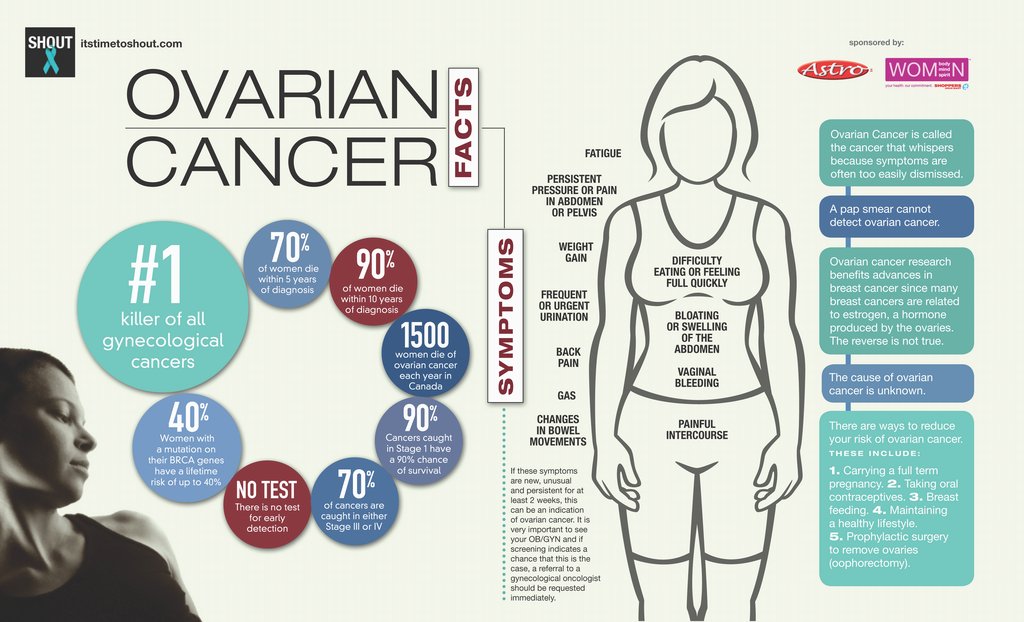
Symptoms are often misdiagnosed, as they can be confused with symptoms of other less severe illnesses, particularly gastrointestinal complaints.
The majority of patients are only identified in the advanced stages when the disease becomes more difficult to treat. There is no routine, simple test to accurately detect ovarian cancer.
There is no accurate and reliable screening test for ovarian cancer. What we do know is that a number of factors increase a woman’s risk of developing ovarian cancer:
Age: The majority of cases of ovarian cancer occur in women over the age of 55, once women have gone through menopause. Some types of ovarian cancer can appear in young women.
Family history: Women who may be at a higher risk (relative to the general population) of developing ovarian cancer are those who on either their father’s or mother’s side of the family have two or more relatives who have had ovarian, breast, colon or uterine cancer.
Symptoms are often misdiagnosed, as they can be confused with symptoms of other less severe illnesses, particularly gastrointestinal complaints.
Genetics: Being a known carrier of abnormalities in the BRCA1 or BRCA2 genes (genes that help to repair cell damage) also increases the risk.
Other factors: Women who have not had children, never taken the contraceptive pill, who started their periods at an early age or whose menopause started at a later age than average have a higher risk of developing ovarian cancer.Women who have previously had endometriosis may be more likely to develop ovarian cancer.
5 Facts Everyone Should Know About Ovarian Cancer
Fact 1: All women are at risk for ovarian cancer.
Ovarian cancer is diagnosed annually in nearly a quarter of a million women globally, and is responsible for 140,000 deaths each year. Unlike some other cancers, developing and developed nations are similarly affected by the disease. It is important to be aware of symptoms, risk factors and your family history on both your father’s and mother’s side of the family.
incidence_mortality
Fact 2: Awareness of the symptoms of ovarian cancer may enable women to receive an earlier diagnosis, when the disease is more easily treatable.
If a woman experiences one or more of the following symptoms frequently it is important that she discuss them with her doctor. Increased abdominal size / persistent bloating (not bloating that comes and goes)
• Increased abdominal size / persistent bloating (not bloating that comes and goes)
• Difficulty eating/feeling full quickly
• Abdominal or pelvic pain
• Needing to pass urine more urgently or more frequently
While these symptoms are often associated with more common and less serious conditions it is better to check them out.
Fact 3: Diagnosis at an early stage vastly improves a woman’s chance of survival
When ovarian cancer is detected at an early stage, when the cancer remains confined to the ovary, up to 90% of women are likely to survive for more than five years (the length of time over which survival is normally measured when assessing cancer treatment). A woman who has symptoms suggestive of ovarian cancer should be referred directly to a specialist to obtain an accurate diagnosis. If she is diagnosed with ovarian cancer, a gynecologic oncologist, who is a specialist who treats women’s cancers, is the best person to manage her care.
Fact 4: Ovarian cancer is often diagnosed at a late stage
Ovarian cancer is frequently diagnosed when the cancer is already at an advanced stage and women often delay seeking help. This may be because the woman thinks her symptoms are due to ‘the time of the month’, ‘menopause’, ‘something I ate’ or confused with other common stomach and digestive complaints. Doctors also often initially suspect less serious causes for the symptoms, but the frequency of symptoms should help them know when to consider ovarian cancer, that is why using a symptom diary might be helpful.
Fact 5: Many women mistakenly believe a cervical smear test (or Pap test) will detect ovarian cancer.
It does not. It detects pre-cancerous changes to cells of the cervix, which is treated much more successfully than ovarian cancer.
More information is available on ovariancancerday.org

No comments:
Post a Comment